The short version
Controls skills are hard to hire and costly to learn on a running line.
ControlsTrainer gives every learner a safe, realistic control panel where they wire, program, commission and troubleshoot the system themselves. See the numbers behind the need.
Practice on a working control panel
Learners wire the panel terminal to terminal, program the PLC and find the fault themselves, instead of watching someone else do it.
How it works →Standards-informed practice
Lessons draw on NEC, NFPA 79, NFPA 70E and OSHA, and the simulator checks selected wiring and safety requirements built into each exercise.
See it course by course →Track and document every learner
Assignments, due dates, refreshers, a skills matrix and printable records to show your auditors and insurer.
See the manager tools →What sets us apart
Hands on, not hands off.
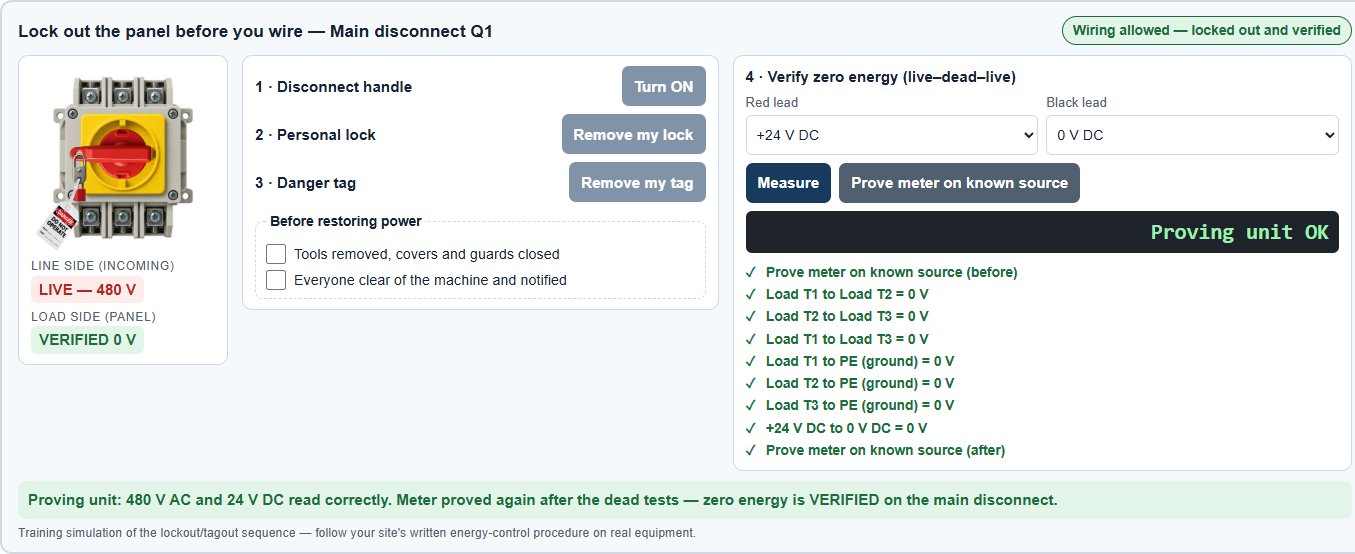
Video courses show someone else doing the work. In ControlsTrainer, the learner does it: lands every conductor, writes the ladder logic, sets up the drive, tubes the valves, locks out the machine and proves it dead. The simulator checks the work the way a good supervisor would, and it doesn’t accept shortcuts.
Doing beats watching
Failure rates in college science, engineering and math courses, from a review of 225 studies
Students in traditional lectures were 1.5 times more likely to fail.
| What the learner gets | ControlsTrainer | Video courses | PLC logic simulators | Hardware trainer benches |
|---|---|---|---|---|
| Wires the panel, terminal to terminal | ✓ Yes | Watches it done | No panel wiring | ✓ Yes |
| PLC programming | ✓ Yes | Watches it done | ✓ Yes | ✓ Yes |
| Drives, pneumatics, HMI and safety circuits in one program | ✓ Ten levels | Varies | Logic only | Extra modules |
| Lockout and live-dead-live testing, step by step | ✓ Enforced | Explained | No | Instructor-led |
| Selected wiring and safety requirements checked | ✓ Automatically | No | No | By the instructor |
| Faults to find and acceptance tests to pass | ✓ Yes | No | Some | By the instructor |
| Every learner practicing at once, anywhere | ✓ In a browser | ✓ Yes | ✓ Yes | Shared stations |
What each type of training typically offers; individual products vary.
Modeled on the equipment in U.S. plants.
Each lesson is modeled on equipment families your people will meet on the job, and terminals use standard designations, such as A1 and A2 on a contactor coil and 95–96 on an overload contact.
Controllers and operator terminals
- Allen-Bradley MicroLogix 1400
- CompactLogix 5069-L306ER
- 5069 I/O modules
- PanelView Plus 7
Drives and power
- PowerFlex 525 drive
- 194R fused disconnect
- 140MT motor protectors
- 1489 circuit breakers
- MEAN WELL DR-75-24
- Phoenix Contact distribution blocks
Machine safety
- Guardmaster 440R-D22R2 safety relay
- 100S safety contactors
- SensaGuard and Trojan guard interlocks
- ROSS DM1C safe-exhaust valve
Pneumatics and sensing
- Festo MS6 filter-regulator
- Festo VTUG valve terminal
- Festo SDE5 pressure switch
- SMC MHZ2 gripper
The simulator holds the line.
- Wiring stays locked until the machine is switched off, locked, tagged and proven dead.
- A second conductor on a terminal is refused, with the reason.
- A jumper across an E-Stop contact, or a link between two safety channels, is rejected as unsafe.
- If a reset could restart the machine, the acceptance test fails.
- Meter readings taken with the meter off, or before power changed, don’t count.
- Completion takes a working machine, not just wiring that looks right.
Independent training platform: product names identify the real equipment each lesson models. All product names and trademarks are the property of their respective owners. ControlsTrainer is independent and is not sponsored, approved or endorsed by these manufacturers.
Standards in the lessons
Standards-informed practice across the program.
The lessons draw on the codes and standards that govern U.S. industrial electrical work: the National Electrical Code (NFPA 70), NFPA 79 for industrial machinery, NFPA 70E for electrical safety in the workplace, OSHA 29 CFR 1910 and UL 508A panel practice. The simulator checks selected wiring and safety requirements built into each exercise, such as locking out and proving zero energy before any wiring.
- NEC (NFPA 70)
- NFPA 79
- NFPA 70E
- OSHA 1910.147 Lockout/Tagout
- OSHA 1910 Subpart S
- UL 508A
| Course | What the course practices |
|---|---|
| Level 1 · Guided Motor StarterFree |
|
| Level 2 · TroubleshootingFree |
|
| Level 3 · Automatic Pump Control |
|
| Level 4 · VFD Conveyor Commissioning |
|
| Level 5 · Pneumatic Pick & Place Cell |
|
| Level 6 · Controls Engineer |
|
| Level 7 · Technician Challenge |
|
| Level 8 · Analog Process Control |
|
| Level 9 · HMI Machine Interface |
|
| Level 10 · Integrated Production Cell |
|
What this means, and what it doesn’t. ControlsTrainer teaches standards-informed practice in an educational simulation. It does not certify a person, machine or workplace, and it doesn’t replace your written procedures, qualified-person training, hands-on evaluation or authorization to work. Always work to the current edition of each code and your authority having jurisdiction. The full scope statement is on our Standards & Compliance page.
Manager and instructor tools
Run it like a program, not a pile of videos.
Company plans include the tools to organize training and prove it happened.
- Assign levels to individuals or groups, with due dates.
- Automated reminders and scheduled refreshers.
- A skills matrix: passed, assigned, due soon and overdue at a glance.
- Team progress, lesson stages and active training time.
- CSV exports and printable training reports.
- Private training messages between learners and their managers.
- An optional leaderboard that ranks completion, never speed.
Completion records describe assigned training, not workplace qualification.

The need
The need is real, and it’s growing.
Industry is short of people who can wire, program and troubleshoot control systems, and experienced people keep retiring or leaving the field. The next generation has to learn fast, and it has to learn the right way.
U.S. manufacturing jobs may need to be filled from 2024 to 2033, and about 1.9 million of them could go unfilled if the skills gap isn’t closed.
Deloitte and The Manufacturing Institute, 2024 1openings a year for industrial machinery mechanics, maintenance workers and millwrights. Employment is projected to grow 14% from 2025 to 2035, much faster than average.
U.S. Bureau of Labor Statistics 2openings a year for electricians. Employment is projected to grow 9% from 2025 to 2035, also much faster than average.
U.S. Bureau of Labor Statistics 3manufacturing jobs sat open in a typical month of 2026, between about 440,000 and 580,000 each month from January to July.
BLS Job Openings and Labor Turnover Survey 4of manufacturers surveyed (54.9%) name attracting and keeping a quality workforce as a primary business challenge.
National Association of Manufacturers, Q3 2026 5a year is lost to unplanned downtime by the world’s 500 largest companies, about 11% of their revenue, by Siemens’ estimate. At a large automotive plant, an hour of downtime costs about $2.3 million.
Siemens, The True Cost of Downtime 2024 6Growing much faster than the average job
Projected U.S. employment growth, 2025–2035
Manufacturing jobs left open, month after month
U.S. manufacturing job openings in 2026, seasonally adjusted
*July is preliminary and may be revised.
3.8 million manufacturing jobs to fill by 2033
About half could go unfilled if the skills gap isn’t closed.
- Other jobs to fill
- Could go unfilled: about 1.9 million
Each figure stands for 380,000 jobs.
Hard to hire for, costly to stop
Two numbers behind the need for trained technicians
of manufacturers in NAM’s Q3 2026 survey name attracting and keeping a quality workforce as a primary business challenge 5
of revenue is lost to unplanned downtime at the world’s 500 largest companies, by Siemens’ estimate 6
The knowledge is walking out the door. The Bureau of Labor Statistics expects many of these openings to come from replacing workers who retire or leave the field.2 Their replacements have to learn controls somewhere. Too often, that place is a live production line, with real energy and real downtime at stake.
Safety and insurance
Safer crews can mean lower premiums.
Electrical and machine work still injures and kills people every year, and those injuries show up in workers’ compensation premiums. Training that prevents injuries protects your people first. Over time, it can protect your premium too.
U.S. workers died from exposure to electricity on the job in 2024. Another 4,900 electrical injuries in private industry cost workers time away from work in 2023 and 2024.
U.S. Bureau of Labor Statistics 8Lockout/tagout was OSHA’s fourth most-cited standard in fiscal 2025, with 2,562 citations. Machine guarding was tenth.
OSHA; NSC Safety+Health 9is the National Safety Council’s estimate of what one medically consulted work injury cost in 2024, counting lost wages, medical and administrative costs.
National Safety Council, Injury Facts 10Workers killed by electricity on the job
U.S. deaths from exposure to electricity, 2015–2024: 1,445 in ten years, about 145 a year.
Dark bars: from 2023, BLS codes these deaths under its newer injury classification, a break in the series.
OSHA’s 10 most-cited standards, fiscal 2025
Citations after federal OSHA inspections. Orange: the two closest to controls work, which ControlsTrainer practices in lockout and guard-interlock exercises.
How training can lower your premium
Fewer injuries, fewer claims
OSHA estimates that following its lockout/tagout standard prevents about 120 deaths and 50,000 injuries a year, and that workers hurt by hazardous energy lose an average of 24 workdays.11 Lockout, zero-energy checks and safe restarts run through the courses.
A lower experience mod
In most states, your experience modification rate (EMR, or “mod”) compares your own losses with those expected for employers like you, usually over three years of history.12 Fewer claims bring the mod down over time.
A lower premium
Your mod multiplies your premium, so a lower mod means a lower bill.12
Example: on a $100,000 base premium, a 1.20 mod costs $120,000 and a 0.85 mod costs $85,000. That is a $35,000 difference for every year the mod applies. (Illustration only. Your carrier calculates your actual mod.)
What your experience mod does to a $100,000 premium
The same base premium at five different mods. Below 1.00 is a credit; above 1.00 is a debit.
- Credit mod: you pay less
- 1.00: the average for your class
- Debit mod: you pay more
Credit for your safety program
In many states, insurers may apply schedule-rating credits or debits based on factors that can include how employees are selected, trained and supervised. North Carolina’s plan, for example, allows up to a 25% credit or debit; caps and factors vary by state and insurer.13 Documented training gives your underwriter evidence to consider.
State safety discounts
Pennsylvania gives a 5% workers’ comp premium discount to employers with a state-certified workplace safety committee.14 Delaware credits employers that pass its workplace safety inspections, and New York credits employers with an approved safety program.15,16 Training supports those programs; each state sets its own rules.
Less OSHA exposure
OSHA penalties reach $16,550 for each serious violation and $165,514 for each willful or repeated violation.17 Lockout/tagout and machine guarding are both on OSHA’s most-cited list.
Your safety record and your bids
Owners and general contractors often check a contractor’s EMR before awarding work, and some won’t hire a firm whose EMR is above 1.0.18 A strong safety record keeps you on the bid list.
A safer lab for students
Students make their first mistakes on a simulator, with no live energy within reach. They meet the real panel already knowing the lockout and the test sequence.
Records you can show
Completion records and certificates, assignments with due dates and refreshers, the skills matrix, printable training reports and CSV exports give your broker and auditors something concrete.
Built to fit your safety program. OSHA requires electrical safety training to be classroom or on-the-job,19 its lockout/tagout standard requires employers to train authorized employees and certify that the training is kept up to date,20 and NFPA 70E calls for electrical safety retraining at least every three years.21 ControlsTrainer gives your people realistic practice and gives you dated records and scheduled refreshers. Your site procedures and on-the-job verification complete the program.
No promises we can’t keep. Every carrier and every state is different, and we can’t promise a discount. Ask your broker or carrier how documented training is treated on your policy.
Who it’s for
Built for your classroom, your plant and your crew.
Schools and training programs
High school CTE, community and technical colleges, apprenticeship and workforce programs
- Give every student a panel. Hardware trainer stations are costly and shared. ControlsTrainer runs in a web browser, so every student wires, programs and troubleshoots, in class or at home.
- Teach the code way from day one. NEC, NFPA 79, NFPA 70E and OSHA practice are built into every course.
- A safe place for first mistakes, with no live energy in the room.
- Run your class: assign levels, set due dates, follow progress in the skills matrix and export results to CSV.
- Funding: Perkins V lets local recipients spend grant funds on industry-aligned equipment, hardware and software, and on simulated work environments.22 Check with your CTE director.
- Try Levels 1–2 free today. For your class, ask for a free 30-day trial or for classroom pricing.
Factories and plants
Maintenance, reliability, operations, training and EHS teams
- Build your maintenance bench before retirements hit, and cross-train mechanics into controls.
- Practice away from the line: troubleshooting, lockout and safety circuits with no downtime and no live energy.
- One training path for every shift and site. Assign it, track it, refresh it.
- Documented training for audits, insurers and your safety program.
- Troubleshoot from the drawing and the meter, not by guesswork, before the next breakdown.
Industrial companies
Electrical contractors, system integrators, panel shops, OEM machine builders and service companies
- Onboard new techs to your standard: NFPA 79 colors, one conductor per terminal, grounding and bonding, and wire numbers from the drawing.
- The same standards-informed habits on every crew and every job site.
- Protect your safety record, which follows you into insurance renewals and bid lists.
- Records you can show customers who ask how your people are trained.
- A capstone that proves it: Level 10 is a complete production cell with a drive, pneumatics, an HMI and a hardwired safety system.
Plans
See it for yourself.
Levels 1 and 2 are free to try without an account. To save your pass and get your certificate, log in or create a free account. Every company plan includes all ten levels and the manager tools.
Team
1–20 seats
Or $29 per user per month, billed monthly.
Business
21–249 seats
Or $29 per user per month, billed monthly.
Enterprise
250+ seats
Annual agreement, quoted for your needs.
Schools and training programs: ask us about classroom pricing. Want to see it with your own people first? Ask for a free 30-day trial for up to 10 learners.
- Schools and company programsRequest a demo, free trial or pricing
- Product questionsAsk a question
- Customer supportSupport & FAQ or get help
Sources
- Deloitte and The Manufacturing Institute, “Taking charge: Manufacturers support growth with active workforce strategies,” April 2024. deloitte.com
- U.S. Bureau of Labor Statistics, Occupational Outlook Handbook, “Industrial Machinery Mechanics, Machinery Maintenance Workers, and Millwrights,” 2025–35 projections. bls.gov
- U.S. Bureau of Labor Statistics, Occupational Outlook Handbook, “Electricians,” 2025–35 projections. bls.gov
- U.S. Bureau of Labor Statistics, Job Openings and Labor Turnover Survey, Table 1, job openings by industry, seasonally adjusted, manufacturing, January–July 2026 (July preliminary). bls.gov
- National Association of Manufacturers, Manufacturers’ Outlook Survey, Third Quarter 2026. nam.org
- Siemens, “The True Cost of Downtime 2024.” siemens.com (PDF)
- Freeman, S., et al., “Active learning increases student performance in science, engineering, and mathematics,” Proceedings of the National Academy of Sciences 111(23), 2014. nih.gov
- U.S. Bureau of Labor Statistics, Census of Fatal Occupational Injuries 2024, Table 2, and Survey of Occupational Injuries and Illnesses, 2023–2024 case and demographic tables (private industry, cases with days away from work). bls.gov · bls.gov (table R64)
- OSHA, “Top 10 Most Frequently Cited Standards,” fiscal year 2025; citation counts reported by NSC Safety+Health, “OSHA reveals final ‘Top 10’ data for FY 2025,” April 29, 2026. osha.gov · safetyandhealthmagazine.com
- National Safety Council, Injury Facts, “Work Injury Costs,” 2024 data (estimates of the cost to society). nsc.org
- OSHA Fact Sheet, “Lockout/Tagout” (DEP FS-3529). osha.gov (PDF)
- National Council on Compensation Insurance (NCCI), “ABCs of Experience Rating.” ncci.com
- North Carolina Rate Bureau, “Schedule Rating Plan,” an example of a state plan with a 25% maximum credit or debit; caps and factors vary by state and insurer. ncrb.org (PDF)
- Pennsylvania Department of Labor & Industry, “State Certified Workplace Safety Committee Program.” pa.gov
- Delaware Department of Insurance, “Workplace Safety Program.” delaware.gov
- New York State Department of Labor, “Workplace Safety and Loss Prevention Incentive Program (WSLPIP)” fact sheet P890. ny.gov
- OSHA, “2026 OSHA Civil Penalties Update,” memorandum, May 21, 2026 (the 2025 maximums remain in effect for 2026). osha.gov
- Associated General Contractors of America and others, comments to OSHA, Docket No. OSHA-2025-0040, 2025. agc.org (PDF)
- OSHA, 29 CFR 1910.332, Training (electrical safety-related work practices). osha.gov
- OSHA, 29 CFR 1910.147, The control of hazardous energy (lockout/tagout), paragraph (c)(7). osha.gov
- NFPA 70E, Standard for Electrical Safety in the Workplace; training and retraining requirements as summarized by Jim Phillips, Electrical Contractor magazine, March 2024. ecmag.com
- Strengthening Career and Technical Education for the 21st Century Act (Perkins V), Sec. 135(b)(5), 20 U.S.C. 2355. uscode.house.gov
- U.S. Bureau of Labor Statistics, Employment Projections 2025–2035 news release (total employment projected to grow 3.5 percent). bls.gov
- U.S. Bureau of Labor Statistics, Census of Fatal Occupational Injuries, Table 2 of the annual news releases (exposure to electricity, 2015–2022, final data); 2023 onward is coded under OIICS 3.02, which BLS notes is a break in series. bls.gov (2018–2022) · bls.gov (2016–2020) · bls.gov (2015–2019)