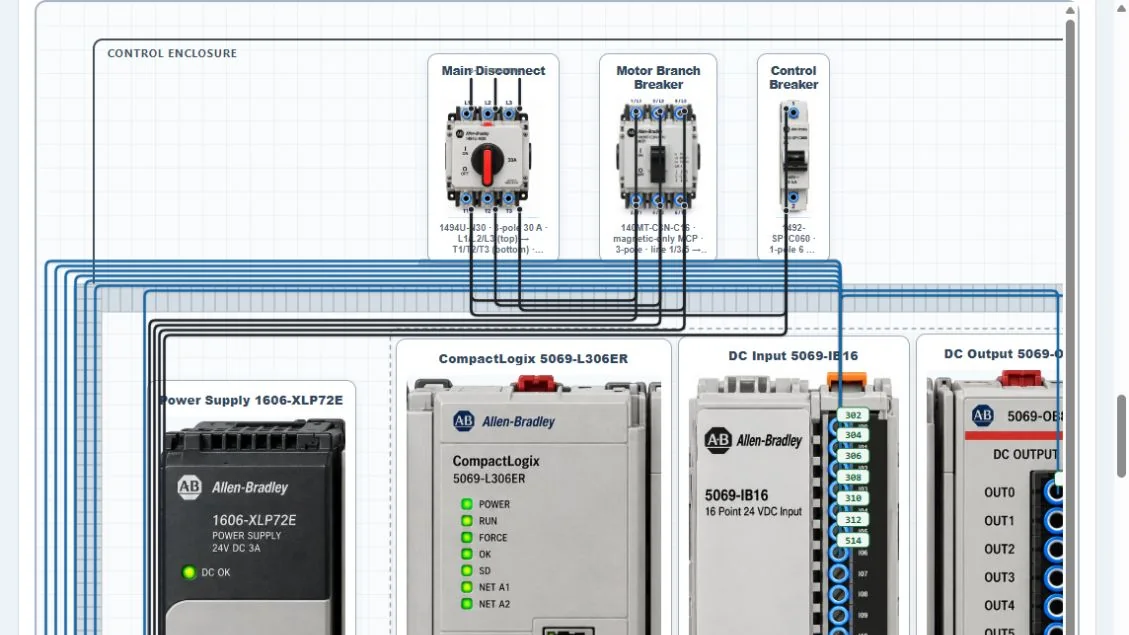
Practice the whole control system
The ten-level program progresses from basic control wiring and troubleshooting to PLC I/O, motor control, variable-frequency drives, HMI development, analog instrumentation, pneumatic motion and integrated commissioning. Exercises ask the learner to make connections, assign addresses, build logic, verify behavior and respond to faults.
The simulations use realistic terminal names, device behavior, wire numbers, drawings and acceptance checks. They are designed to make the relationship between a schematic, a panel and a running process easier to understand.
PLC and industrial automation skills
Electrical controls
Control-panel wiring, 24 VDC distribution, motor starters, overloads, safety circuits, grounding concepts, conductor identification and drawing-based verification.
PLC and HMI
PLC inputs and outputs, ladder logic, program download and run modes, HMI tags, alarm behavior, sequencing and fault recovery.
Drives and instrumentation
PowerFlex VFD setup, motor control, analog scaling, pressure and level signals, commissioning checks and diagnostic reasoning.
Pneumatics and motion
Valve manifolds, cylinders, grippers, pressure verification, stored pneumatic and gravitational energy, safe state behavior and troubleshooting.
Training with recognizable industrial devices
ControlsTrainer uses real device families and documented terminal conventions wherever practical. Current and planned lessons include equipment and components associated with widely used industrial brands:
Allen-Bradley and Rockwell Automation
MicroLogix 1400 PLC hardware, including the 1766-L32BXB, PowerFlex variable-frequency drives, PanelView-style HMI concepts and Guardmaster safety-control examples.
Festo and SMC
Festo pneumatic valves, cylinders, guided axes, pressure sensing and flow components, plus SMC pneumatic devices such as the MHZ2-16C parallel gripper.
Schmersal and SICK
Schmersal AZ 16 machine-door interlocks and SICK industrial proximity sensors used to teach field-device wiring and diagnostic feedback.
Industrial panel components
Mean Well DC power supplies, Phoenix Contact distribution and terminal products, motor-control devices, relays, contactors and field wiring hardware.
Independent training platform: Brand and product names are used for identification and educational context. All trademarks belong to their respective owners. ControlsTrainer is independent and is not sponsored, approved or endorsed by those manufacturers.
Safety and compliance are part of the lesson
Industrial controls training must address more than whether a circuit runs. ControlsTrainer includes hazardous-energy awareness, lockout and tagout sequences, electrical and pneumatic isolation, stored-energy verification, restart prevention and fault-response exercises.
The platform explains where an exercise is a training abstraction and links its compliance discussion to standards and manufacturer information. Simulated completion does not authorize work on real machinery. Real installations require employer procedures, qualified supervision, current manufacturer documentation, risk assessment and the rules that apply at the worksite. Read the Standards & Compliance page for the full scope statement.
Created by John Clore
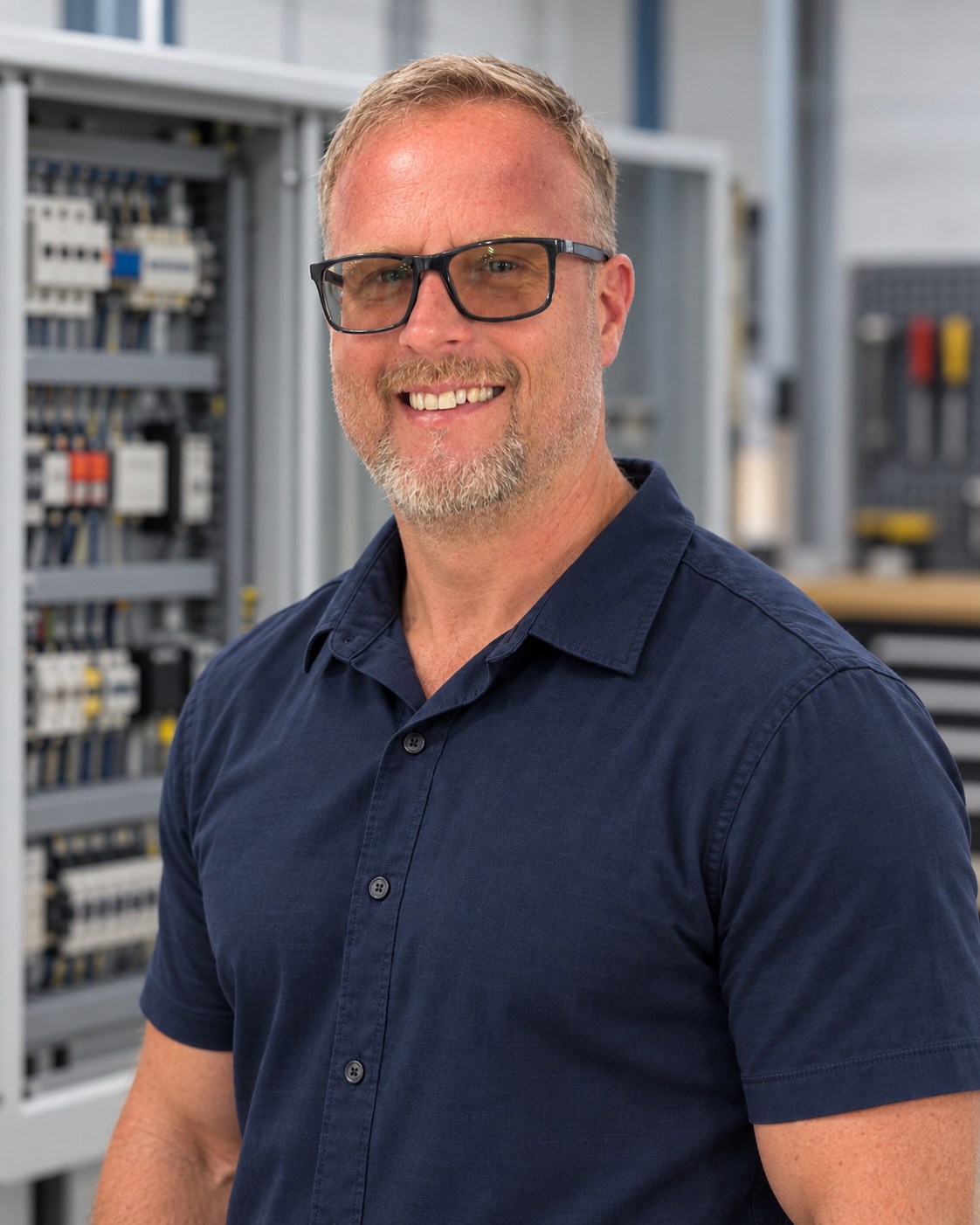
ControlsTrainer is created and developed by John Clore to make industrial automation practice available through an interactive website. Since 2023, John has studied automation and controls at Lansing Community College, earning the Electrical Technology – Control Maintenance and Control Panel Wiring certificates and an OSHA 30-Hour General Industry card.
On the plant floor, he has worked as an industrial electrical technician in automotive manufacturing. He has also been a panel builder and industrial electrician, building and checking out control panels for conveyors and assembly lines, and a maintenance technician troubleshooting electrical and mechanical faults and training staff.
Before that, John spent more than a decade building websites and software. In 2014 he co-created D-Vasive, a privacy app for Android phones and Windows PCs that alerted users when an app switched on the camera, microphone, Bluetooth or Wi-Fi, and let them lock each one. As co-founder, vice president and application designer, he expanded the original camera-and-microphone alert into the full app, designed its user experience and created its brand and website. He also signed on John McAfee, the founder of McAfee antivirus, as a 30% shareholder and the public face of the app.
ControlsTrainer brings the plant floor and the software together: control-system diagrams, realistic device interfaces, guided exercises and immediate feedback in one progressive training path, held to the standard of a real panel.
Safety isn’t a chapter in ControlsTrainer. It runs through every level. You lock it out and prove it dead before you wire, a jumpered safety circuit never passes, and nothing restarts on its own. A machine isn’t finished when it runs. It’s finished when it runs safely.
About ControlsTrainer FAQ
Do I need physical PLC equipment?
No. The exercises run in a modern web browser. They provide simulated practice and do not connect to or certify real machinery.
What topics does the course cover?
The levels cover control wiring, troubleshooting, PLC I/O, ladder logic, VFDs, HMI development, analog scaling, pneumatics, commissioning, safety behavior and hazardous-energy awareness.
Does ControlsTrainer represent the listed manufacturers?
No. Manufacturer and product names identify equipment used as educational references. ControlsTrainer is an independent platform with no claimed sponsorship or endorsement.
Where can I get help?
Visit Support & FAQ or send us a question.