THE WRITTEN GUIDE
Follow the steps.
Use the video with the instructions below. All equipment actions described here refer to the simulator.
Identify the hazard and safeguard
OSHA 1910.212(a)(1) addresses protection against hazards including nip points and rotating parts. Use the lesson requirements to identify what the conveyor safeguard is intended to protect. A physical guard, an interlock and the control response each have a different role.
Locate the guard interlock and safety relay
Inspect the actual devices on the Level 6 wiring board. Follow the guard and E-stop channels to the safety relay and the intended output-control path. Do not assume an ordinary PLC rung provides a safety-rated function merely because it stops the animation.
Observe the normal operating state
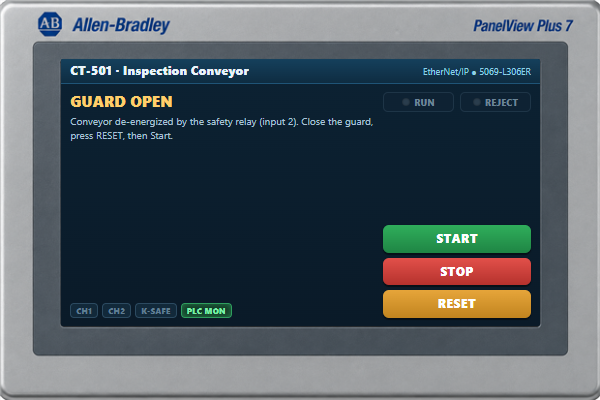
After completing the lesson setup, run the conveyor as directed. Read the operator terminal and the status indications. Establish the normal condition before testing the guard so you can compare what changes when the interlock opens.
Open the simulated guard
Use the lesson guard control. Observe the guard-open state and the RUN indication turning off. The machine response should match the required safety-circuit behavior. Watch the relevant status and output feedback rather than relying on a general production animation.
Close, reset and deliberately restart
Close the guard and observe the reset-required state. Apply the permitted reset and verify READY with RUN still off. Reset rearms the system; it should not serve as the operating Start command. Use a separate deliberate Start action when the lesson permits it.
Test recovery as well as stopping
Complete the lesson’s required recovery and held-start checks. Document what the circuit did, including any unexpected restart. Real safeguarding requires a machine-specific risk assessment, suitable components, installation and validation; this simulation demonstrates selected control behavior.
A FEW USEFUL DISTINCTIONS
Common questions.
Does closing a guard start the conveyor?
The lesson requires a controlled recovery sequence. Closing, resetting and deliberately starting are separate actions.
Can a normal PLC replace the safety relay?
Do not assume that ordinary PLC control provides the required safety function. This lesson includes a separate hardwired safety-relay circuit.
Is a guard interlock a lockout device?
No. Guarding during operation and isolating hazardous energy for servicing are different functions. Follow the applicable energy-control procedure for servicing.
Read the full video transcript
Machine guarding is more than making a conveyor stop. The recovery sequence matters too. Watch the actual guard and safety circuit in Controls Trainer Level Six.
Begin with the hazard. OSHA nineteen ten point two one two addresses protection against hazards such as nip points and rotating parts. Identify the safeguard required for the job.
Now locate the guard interlock and safety relay on the wiring board. Follow the device connections. The ordinary PLC program is not automatically a safety-rated system.
With the lesson running, observe the normal indications. Open the simulated guard and watch the guard-open state and the Run indication turn off. These are the device and control states that demonstrate the response.
Close the guard. The system now requires a reset. Apply the permitted reset and observe Ready, with Run still off. Reset rearms the circuit; it is not the operating Start command.
Use a separate deliberate Start action when the lesson permits it. Complete the required recovery and held-start tests as well as the stopping test.
An interlocked guard does not replace energy isolation for servicing. Real safeguarding requires an equipment-specific risk assessment and validation.
Explore the complete inspection-conveyor and safety-relay exercise in Controls Trainer Level Six.
References used in this guide
References identify the subjects discussed. The examples do not establish compliance of a real machine or qualification of a person.
Controls Trainer is an independent educational platform. These examples supplement equipment-specific instruction and practical evaluation. Completion is not OSHA certification, an electrical license, or authorization to work on equipment.